Nigeria’s fake food crisis is growing. Learn about counterfeit foods, health risks, NAFDAC warnings, and practical tips to identify and avoid fake products.
Over the past few months, a growing wave of social media exposés has forced Nigerians to confront an uncomfortable question: is the food on supermarket shelves actually what it claims to be?
From counterfeit infant cereal to fake yogurt packaged in unsanitary backrooms, the “fake food” trend has moved from whispered market gossip to a full-blown national conversation, one that has regulators, manufacturers, and doctors scrambling to respond.
How the Trend Exploded Into Public View
The current wave of concern gained real momentum in early September 2026, when videos began circulating online showing what users identified as counterfeit Hollandia yogurt being packaged under filthy, unregulated conditions.
The clips spread rapidly, prompting a broader online campaign in which Nigerians started posting side-by-side comparisons of genuine and suspected fake versions of everyday food, drink, and cosmetic products. That campaign quickly widened into public criticism of the two agencies charged with protecting consumers, the National Agency for Food and Drug Administration and Control (NAFDAC) and the Standards Organisation of Nigeria (SON), with citizens questioning how counterfeit goods keep reaching store shelves despite existing regulation.
But this isn’t a brand-new phenomenon; it’s a slow-burning crisis that has simply reached a tipping point of public attention.
The Products at the Center of the Storm
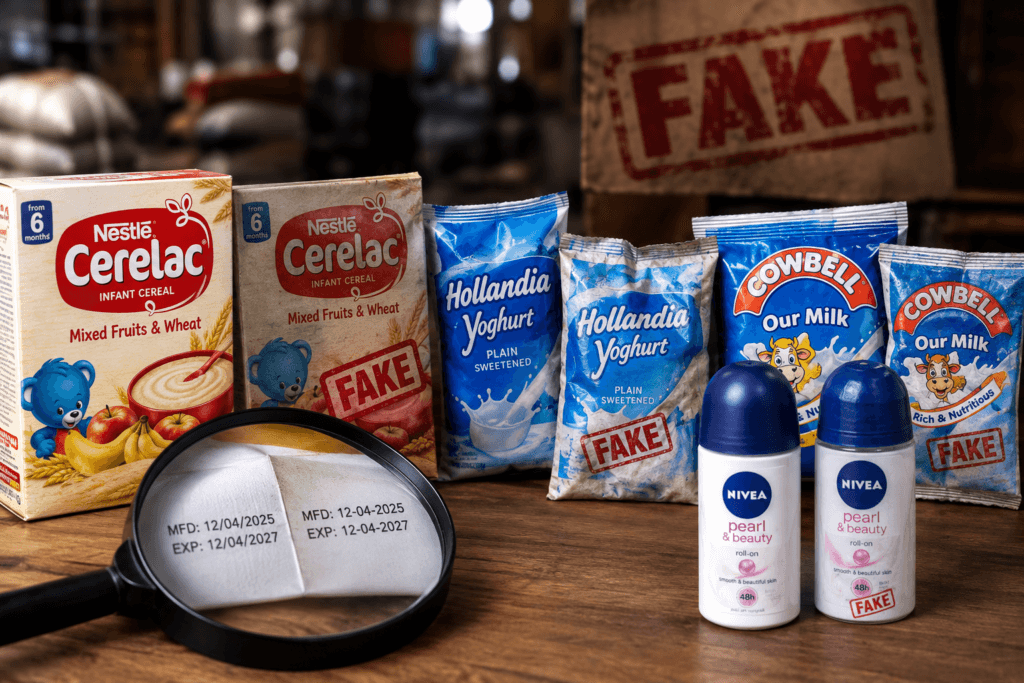
Several specific cases have anchored the discussion:
Fake Cerelac (infant cereal). In March 2026, NAFDAC issued Public Alert No. 018/2026, warning that counterfeit and unregistered Cerelac Mixed Fruits and Wheat was being sold in Lagos. The case surfaced after Nestlé Nigeria, the legitimate manufacturer, received a complaint about a product that smelled like it had been in contact with fuel.
Investigators found the counterfeit had an expiry date that appeared tampered with, and NAFDAC pointed to a subtle but crucial giveaway: the genuine product separates the day and year in its date code with a slash (/), while the fake version used a hyphen (-). Perhaps most alarming, Nestlé Nigeria said it could not trace how the counterfeit entered the country in the first place.
Fake cowbell milk. NAFDAC also flagged counterfeit Cowbell “Our Milk” sachets, reproduced using outdated packaging design and trademarks. According to the agency, the fake product lacked the creamy texture of the real thing and showed signs of poor-quality sealing and printing.
Fake Hollandia yoghurt. The viral videos that kicked off the September 2026 uproar showed yogurt allegedly being packaged in unhygienic conditions using the Hollandia brand name.
Fake rice, drugs, and other staples. This is far from an isolated food problem. NAFDAC’s enforcement record shows a pattern stretching back years: a factory in Nasarawa State packaging fake rice worth over ₦5 billion was shut down in 2024, alongside raids uncovering counterfeit alcohol, powdered milk, vegetable oil, noodles, and bottled water. In total, NAFDAC destroyed more than ₦120 billion worth of substandard and falsified medicines and food products between July and December 2024 alone.
Fake medicines sold alongside food. The line between the fake-food and fake-drug crises has blurred. In February 2026, NAFDAC seized more than 10 million doses of counterfeit malaria medication at Lagos’s Trade Fair Market, discovered inside a warehouse disguised as a spare-parts store, sitting alongside cooking oils, perfumes, and body oils.
Why Is This Happening?
A few overlapping factors help explain why counterfeit food has become so widespread:
- Economic pressure. Nigeria’s high cost of living has pushed both consumers and unscrupulous producers toward cheaper alternatives. For buyers, cheaper products are more affordable; for counterfeiters, it’s easier and far less costly to fake the appearance of a trusted brand than to meet real manufacturing standards.
- Weak supply-chain traceability. In the Cerelac case, even Nestlé Nigeria, the product’s own manufacturer, said it didn’t know how the counterfeit entered the country, exposing serious gaps in import and distribution oversight.
- Regulatory strain. NAFDAC and SON have real legal powers and have carried out large-scale seizures, but critics argue enforcement hasn’t kept pace with how sophisticated and widespread counterfeiting has become, especially given how closely fake packaging can now mimic the original.
- High demand for trusted brands. Counterfeiters specifically target well-known, high-demand products like baby food, milk, yogurt, malaria drugs because brand trust translates directly into a ready market for imitations.
The Health Risks Are Real
This isn’t just a matter of getting a lower-quality product for your money. Medical professionals have linked counterfeit food and drugs to serious health consequences. Dr. Rotimi Adesanya, Director of Medical Services at the Federal College of Education Medical Centre in Akoka, Lagos, has warned that counterfeit food and drugs can contain contaminants capable of damaging vital organs, particularly the liver and kidneys, and has connected the counterfeit trade more broadly to rising cases of liver failure, kidney failure, and infertility in Nigerian hospitals. For infants specifically, fake formula or cereal that lacks proper nutrients or contains harmful substances can cause severe developmental complications.
What Regulators Are Doing About It
NAFDAC has stepped up enforcement in recent years:
- Between July and December 2024, the agency destroyed more than ₦120 billion worth of counterfeit and substandard food and medicine nationwide, with major operations in Lagos, Aba, Port Harcourt, Ibadan, Nasarawa, Kaduna, and Abuja.
- In February 2026, it seized over 10 million doses of fake malaria medication and other products worth roughly ₦3 billion in Lagos, arresting four suspects.
- The agency continues to issue public alerts (like the Cerelac and Cowbell warnings) identifying specific batch codes and packaging differences so consumers can protect themselves.
- NAFDAC’s Director-General, Prof. Mojisola Adeyeye, has urged Nigerians to buy only from reputable, identifiable outlets and to be suspicious of unusually cheap products.
Still, public criticism persists. Commentators argue that while NAFDAC and SON clearly have the capacity to find counterfeit goods, stronger coordination with Nigeria Customs, more consistent prosecutions, and tighter border control are needed to actually stop the supply at its source.
How to Protect Yourself: Practical Tips
- Check the NAFDAC registration number. Every legitimate packaged food or drug product should carry one and verify it rather than assuming it’s genuine, since some counterfeiters now fake the registration number itself.
- Inspect packaging closely. Look for blurry printing, uneven sealing, missing security features, or date codes that look altered. Small formatting details (like a hyphen instead of a slash) have been the exact giveaway in real cases.
- Be wary of unusually low prices. As NAFDAC’s own director-general has warned, an unusually cheap product is often a compromised one.
- Buy from identifiable, reputable outlets. Purchasing from stores with a fixed address and a traceable supply chain makes it far easier to report problems and get accountability.
- Trust your senses. An off smell (like fuel or chemicals), an unusual texture, or a taste that doesn’t match what you’re used to are all warning signs worth acting on immediately.
- Report suspected fakes. Consumers can report suspicious products directly to NAFDAC so the agency can investigate and alert the wider public.
The Bottom Line
Nigeria’s fake food trend is not a passing social media moment; it’s a visible symptom of deeper strain on the country’s supply chains and regulatory enforcement, compounded by economic pressures that make counterfeiting profitable. The recent wave of viral exposure has done something valuable: it has forced public accountability and pushed both NAFDAC and manufacturers like Nestlé to respond publicly and specifically. But lasting change will depend on sustained enforcement, tighter import controls, and consumers staying vigilant every time they shop.
If something about a product looks, smells, or feels off, trust that instinct and report it.
Note: The Hollandia yoghurt and some social-media-sourced claims originate from viral videos and user reports rather than confirmed laboratory findings from NAFDAC at time of writing. They are included because they are central to the public conversation, but should be read as allegations under investigation rather than settled fact.